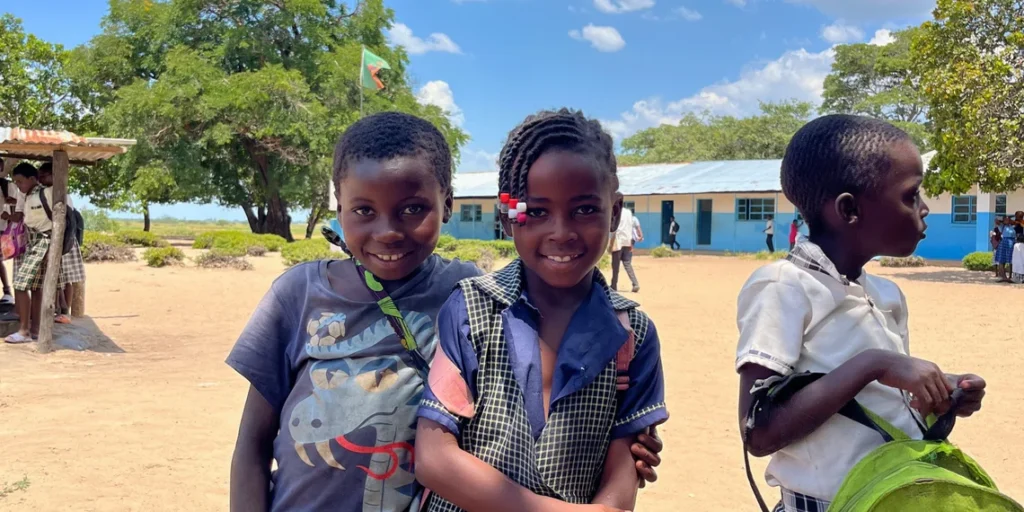
Imagine being a child eager to learn, but your school is hours away on foot. For thousands of children in rural Zambia, this isn’t a story, but a challenging reality that children and young people endure despite the hardship, driven by the desire to shape their own lives.
The situation on the ground
According to the Education Statistics Bulletin (2021), 13% of primary school-aged children do not attend school. This equates to approximately 376,000 girls and boys aged 7–14 who are denied the opportunity for education. Girls are particularly affected, as they are often prevented from attending school by cultural and economic barriers.
In three remote regions of Zambia – Matenda, Makapaela and Ganda – access to education is particularly difficult. Many children have had to walk for hours because the few existing schools were overcrowded and often inaccessible during the rainy season.
Together with our partner organization NACRO (New Apostolic Church Relief Operation), we have already been able to build three new schools here – a first major step towards giving local children a chance at education. But the need is enormous: Over 14,000 children live in the three regions, and almost half the population is under 15 years old.
We aim to achieve this by 2028.
Since 2017, we have been involved in several projects to expand school infrastructure in Matenda and Makapaela , and since 2019 also in Ganda . In rural areas, existing schools are often too small and overcrowded, forcing many children to travel long distances to reach the nearest educational institution. To counteract this, we have already built classrooms, teacher accommodations, and sanitary facilities in recent years. However, despite this progress, the schools are once again reaching their capacity limits.
To enable schools to offer instruction from preschool through the final year of secondary school , additional classrooms are being built. Equally important are accommodations for teachers: this is the only way the government can send a sufficient number of teachers and finance their salaries.
Together we are creating the foundation so that children in Matenda (Luapula Province in northern Zambia), Makapaela (West Province), and Ganda (South Province) no longer have to learn under trees or in makeshift huts – but in safe classrooms with qualified teachers.
Specific measures:
- Expansion of classroom capacity for a total of 520 additional students through two classrooms each for preschool instruction at the Matenda and Ganda schools, and three classrooms each for secondary school classes, including school furniture, at all three schools. This will allow the schools to offer instruction for all grade levels up to the Abitur (university entrance qualification).
- Each school will have a residential building with three bedrooms for the teaching staff , in order to attract and retain qualified teachers provided by the state.
- Establishment of school gardens, each covering 1 hectare , through which children can learn about sustainable agriculture and, above all, vegetable cultivation. The produce is used for school meals and sold, providing the schools with income to finance maintenance work on the water and sanitation infrastructure.
- Improving hygiene through the distribution of hygiene kits and training . These consist primarily of soap, hand sanitizer, and sanitary napkins.
Who benefits?
- 2,000 people . That includes 520 new students, their parents and teachers, as well as future generations.
- Local authorities, community representatives and relevant workers who support the education sector.
That’s why your support counts!
This project is more than just concrete and bricks – it stands for hope, opportunity, and dignity .
With your help, we can get a step closer to our goal: ensuring that no child in Zambia’s rural areas is excluded from education due to long distances, lack of access, or inadequate resources.
Education means far more than reading, writing, and arithmetic – it breaks cycles of poverty and opens up new life prospects for children. Without adequate infrastructure, children, especially girls, risk dropping out of school early, ending up in child labor, or being married far too young.
With improved school buildings, we contribute to ensuring that
- All children should have fair educational opportunities.
- Illiteracy will be eradicated by 2030 – according to Zambia’s “Vision 2030”.
- The school route is shortened to less than 5 km for 75% of the children .
- Safe and dignified working and living spaces have been created for teachers (unfortunately, the profession is still not highly recognized in many countries).
- the local economy has been strengthened – through construction contracts and agricultural initiatives.