
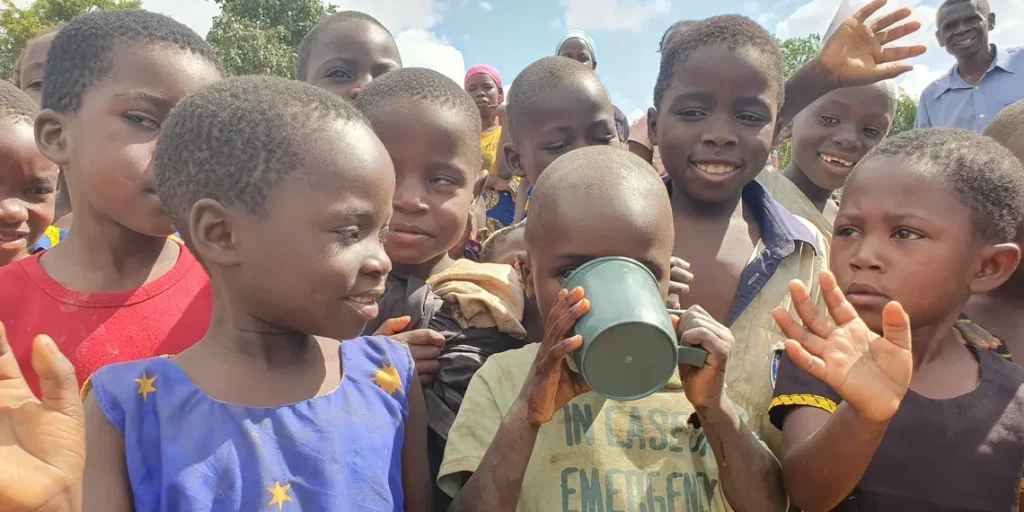
In Malawi, almost two-thirds of children drop out of school – often due to hunger, poverty, or early marriage. In the Mchinji district, we are supporting 2,400 students, 35 teachers, 16 school principals at 5 target schools, as well as 100 villagers and 75 families on a new path. Education, health, and environmental protection are intertwined in this project, opening up real opportunities for children.
A vicious cycle that must be broken.
Children have big dreams – but in Malawi, everyday life throws many obstacles in their way. Two-thirds fail to complete primary school. The reasons are manifold: poverty, hunger, early marriage.
The contrast is already evident on the streets of Malawi in the morning: some children run laughing to school, while others – often very young – carry heavy water canisters to the well. Girls who were married off at a young age can only look longingly towards the school route.
Added to this is the climate crisis: forests are disappearing, fields are eroding, and droughts alternate with floods. Children feel this directly: they go to school hungry and often sit in classrooms without water, electricity, or sanitation. Despite this, many are grateful for the opportunity to learn.
Poverty, lack of education, and environmental destruction reinforce each other. Girls are particularly affected: 38% marry before their 18th birthday, many as early as 15. Early marriage almost always ends their schooling – and the cycle of disadvantage continues.
But there is hope. If education, health, and environmental protection are strengthened together, children and their families can escape this vicious cycle.
Our journey with the people of Mchinji
In the Mchinji district, on the border with Zambia, we support 2,400 pupils at five primary schools in Kavumbwa, Kafulu, Chamwavi, Kavumbwa & Kazira – sustainably and together with the local people.
What we do specifically:
- Improved learning conditions: Renovate classrooms, build barrier-free access, construct toilets, drill wells for clean drinking water.
- Improved teaching quality : 35 teachers will receive further training so that they can teach using modern, participatory methods and better integrate topics such as life skills, health and environmental protection into their lessons.
- Empowering girls : education on sexual and reproductive health, spaces for menstrual hygiene and special programs that promote school attendance.
- Environmental protection : 3,000 trees will be planted in the school’s surroundings.
- Strong communities: Parents, teachers and local leaders receive training in management and organization and thus take responsibility for the schools.
- Increased income: Through savings and credit groups (VSLAs), parents have the opportunity to start small businesses and better cover school costs.
Strengthening teachers — because recognition and joy are important
In Malawi, the teaching profession is often undervalued. Yet dedicated teachers are the key to better education. That’s why we are providing targeted support to 35 teachers and 16 school principals:
- Professional development courses in modern, student-centered methods (Active Teaching & Learning)
- Teaching content on life skills, health and environmental integration
- School leadership and organization training
- Methods for lesson design that promote the joy of teaching and learning
The goal is not only to impart specialist knowledge, but also to strengthen the pedagogical attitude: motivated teachers who teach with enthusiasm ensure motivated children — and that changes entire communities.
Taking responsibility together
This project is part of a larger vision: Malawi aims to have an inclusive education system by 2063. The government needs partners—that’s why we work closely with authorities, village communities, and international supporters. Success will only be possible if teachers, parents, children, local decision-makers, and supporters worldwide work together.
A glimpse into the future: Imagine children arriving at school energized by breakfast; girls feeling safe during their periods; children graduating from school; teachers using modern teaching methods; children learning to protect their villages from soil erosion. This is not a dream—with this project, we are laying the foundation for precisely this future.