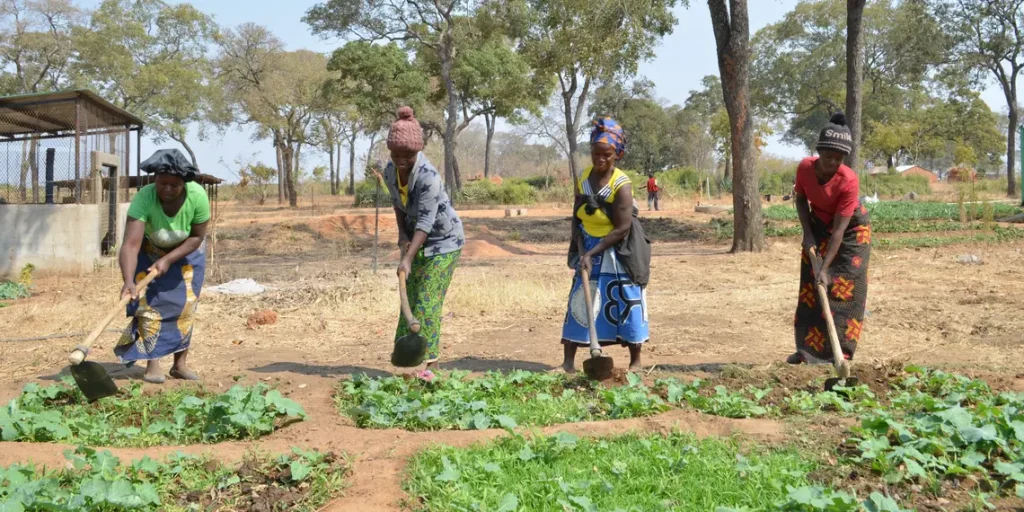
People reached: Rural households and farming communities in the Petauke region. The project builds on the previous initiative, which connected 20 households to the biogas system and provided improved water access to approximately 100 households, while the follow-up project extends clean energy, safe water, agricultural and livelihood opportunities to additional households.
Problem Situation
Before the project, many households in Petauke relied on firewood and charcoal for cooking, contributing to deforestation and exposing families to harmful indoor air pollution. Access to safe water was also limited, with many households dependent on unprotected water sources, while agricultural production remained highly vulnerable to rainfall and climate variability.
Activities
The project expands the existing biogas and water infrastructure through a second biogas plant, wastewater treatment, biogas storage and compression systems, gas stoves, solar-powered water pumping systems, two new boreholes, water tanks and three water kiosks. It also supports forage and horticultural production, drip irrigation, agroforestry, tree nurseries, organic fertilizer production, livestock management and veterinary services, while strengthening cooperatives and savings groups through training, study visits and practical learning.
Community members are actively involved through their registered cooperative, which manages the biogas plant and related infrastructure and develops services and income-generating activities for members and other farmers in the area.
Outputs
Additional households gain access to clean biogas and improved water supplies for domestic use and irrigation, while agricultural and livestock activities are strengthened through improved forage, irrigation, organic fertilizer and technical knowledge. Cooperatives and savings groups are strengthened, and community members receive practical training in cooperative management, climate-adapted agriculture, agroforestry, conservation farming, soil fertility, livestock health and the maintenance of biogas and water infrastructure.
Outcomes & Long-term Impact
Project objective and direct impact: Households improve their food and energy security, access to clean water and resilience to climate variability through reliable renewable energy, improved water infrastructure, more productive agriculture and diversified income opportunities. Reduced reliance on firewood and charcoal also contributes to healthier living conditions and less pressure on local forests.
Overall objective and long-term impact:
The project contributes to sustainable rural development in the Petauke region by strengthening community-based economic structures and enabling households to manage natural resources and essential infrastructure sustainably. A stronger cooperative culture, diversified livelihoods, climate-resilient agriculture and access to clean energy and water provide a foundation for improved living conditions and greater resilience over the long term.
Cooperatives as a Driver of Sustainable Development
The project builds on the cooperatives and savings groups established during the predecessor project. By strengthening cooperative management and supporting services such as veterinary assistance and animal-feed production, the project helps communities develop sustainable local businesses while reinforcing collective ownership of the infrastructure and its benefits.
Training for Sustainable Change
Training and learning are central to the project’s long-term sustainability. Agricultural workers and cooperative members are equipped with knowledge and practical skills in climate-adapted and conservation agriculture, agroforestry, tree nurseries, soil fertility management, livestock husbandry, veterinary services, organic fertilizer and biosludge management, as well as the operation and maintenance of water and biogas systems.