
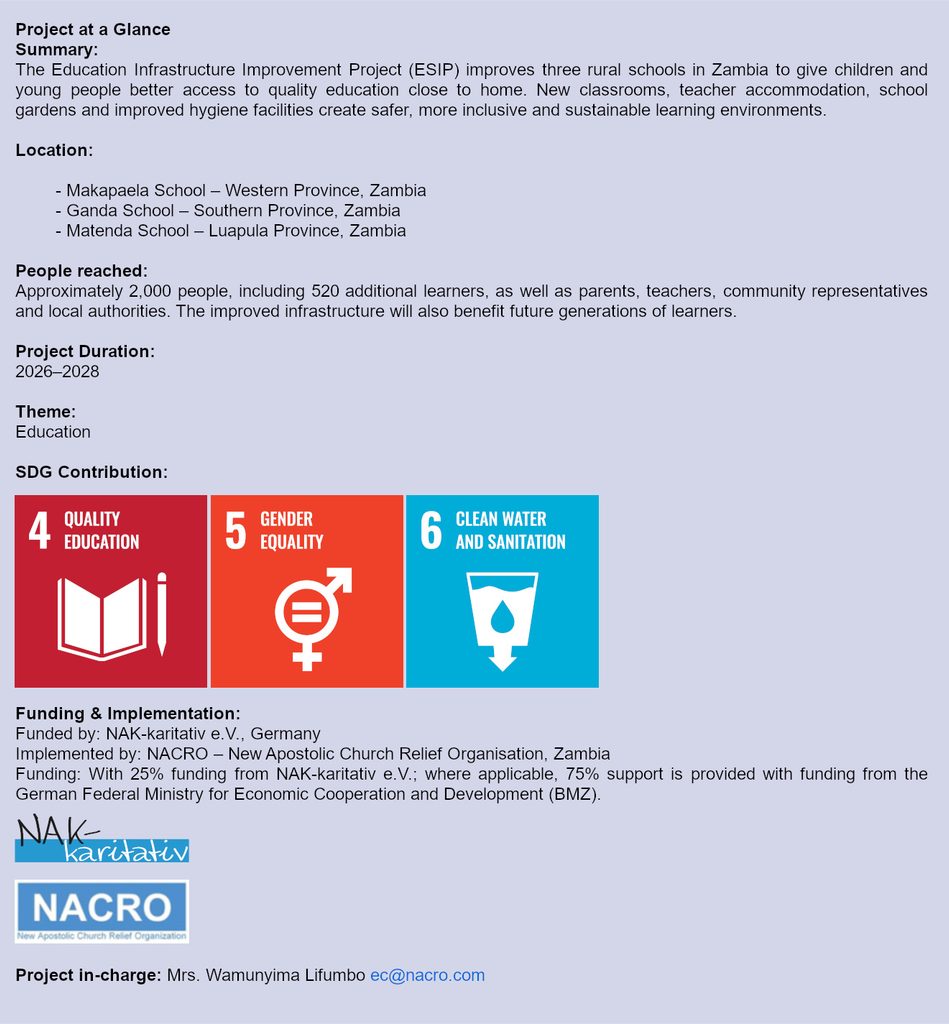
The Education Infrastructure Improvement Project (ESIP) improves three rural schools in Zambia to give children and young people better access to quality education close to home. New classrooms, teacher accommodation, school gardens and improved hygiene facilities create safer, more inclusive and sustainable learning environments.
Problem Situation
Children in rural Zambia face barriers to education due to long distances, overcrowded classrooms, inadequate school infrastructure and limited teacher accommodation. At Makapaela, Ganda and Matenda schools, increasing enrolment is placing growing pressure on existing facilities, while inadequate hygiene conditions create additional barriers to regular school attendance, particularly for girls.
Activities
The project constructs and improves classrooms, teacher accommodation and hygiene facilities at the three schools, while also establishing school gardens to promote practical learning and environmental sustainability. Village communities, parents, teachers and local authorities are involved in planning, implementation and oversight, helping to ensure local ownership and the sustainable use and maintenance of the improved facilities.
– 13 new classrooms: Construction of 9 classrooms for older pupils and 4 classrooms for early years education.
– 3 new teachers’ accommodation units: Provision of housing to enable qualified teachers to stay in the long term.
– 180 new school desks: Fitting out all new classrooms with sturdy, child-friendly school desks, providing a total of 360 seats.
– Hygiene campaigns: Education on water, sanitation and health – supplemented by appropriate hygiene kits, including sanitary products for girls.
– 3 new school gardens: Promoting vegetable cultivation at all three schools to strengthen food security and support school operations.
Outputs
The three schools receive improved and expanded infrastructure, including additional learning spaces, teacher accommodation, hygiene facilities and school gardens. The improved facilities are used and accepted by learners, teachers and communities, enabling more children to attend school in safer, more inclusive and more conducive learning environments.
Outcomes & Long-Term Impact
Project objective and direct impact:
The project increases access to quality education for children in underserved rural communities by reducing infrastructure-related barriers and improving the learning environment. Learners benefit from safer, less overcrowded and more inclusive schools, while improved hygiene facilities particularly support girls’ participation and attendance.
Overall objective and indirect, long-term impact:
In the long term, improved educational opportunities contribute to stronger, more resilient rural communities and better prospects for children and young people. By investing in durable school infrastructure and community ownership, the project supports sustainable access to education for current and future generations.